Authors

Contents
Find out how we can help you navigate environmental markets
Through free, prior and informed consent, communities should help design the carbon projects that directly affect their land and livelihoods, but it can often be treated as a sign-off on a project document. Our Policy Associate, Valentina Hernandez Gomez evaluates how well FPIC is factored into the major carbon crediting standards.
On 9 August, the world marked the International Day of the World's Indigenous Peoples. Two days later, Brazil's Ministério Público Federal (MPF) challenged jurisdictional REDD+ practices followed in the country under Article 7 of CONAREDD+ Resolution 19/2025, arguing the practices are conflicted if a programme governance body both writes and approves any consultation plans.
In simple terms, the challenge says that guidance setters cannot mark their own homework regarding community consent for Brazilian carbon projects designed to protect standing forests.
Brazil's MPF challenge brings back a recurring question: what does it actually take for free, prior and informed consent (FPIC) to be real in carbon projects? How to best navigate the carbon crediting standards requirements and the host countries' expectations and regulations around it?
The MPF grounds its case in the 1989 ILO Convention 169, which guarantees communities the right to be consulted through their own autonomous protocols. Prosecutors argued that standardised, state-led procedures stifle this autonomy, and maintained that FPIC must be an ongoing requirement for every decision, from initial design to contract signing, rather than a one-time approval step.
Brazil's emissions trading regulation reinforces the argument, as it allows communities to opt out of programmes at any stage, confirming that consent is a continuous obligation, not a single signature.
The concerns are hardly new; defining 'real' consent has been a long-standing challenge across the carbon market, becoming even a core consideration in the Integrity Council for the Voluntary Carbon Market’s (ICVCM’s) assessment framework.
At its best, FPIC is the mechanism through which communities co-design the projects that affect their land and livelihoods, bringing their knowledge, governance, and development priorities into the work of the carbon project from the first conversation onwards. Too often, though, FPIC processes operate as something closer to a sign-off on a project document, which communities had little to no hand in writing.
The question is: how close does the carbon market's architecture and operation come to the former rather than the latter?
How do carbon crediting standards actually stack up on FPIC?
The carbon market relies on two benchmarks: the previously mentioned ILO Convention 169 – ratified by 24 states, mostly from Latin America and the Caribbean – and the 2006 United Nations Declaration on the Rights of Indigenous Peoples, UNDRIP, a non-binding declaration adopted by 147 states in the United Nations General Assembly.
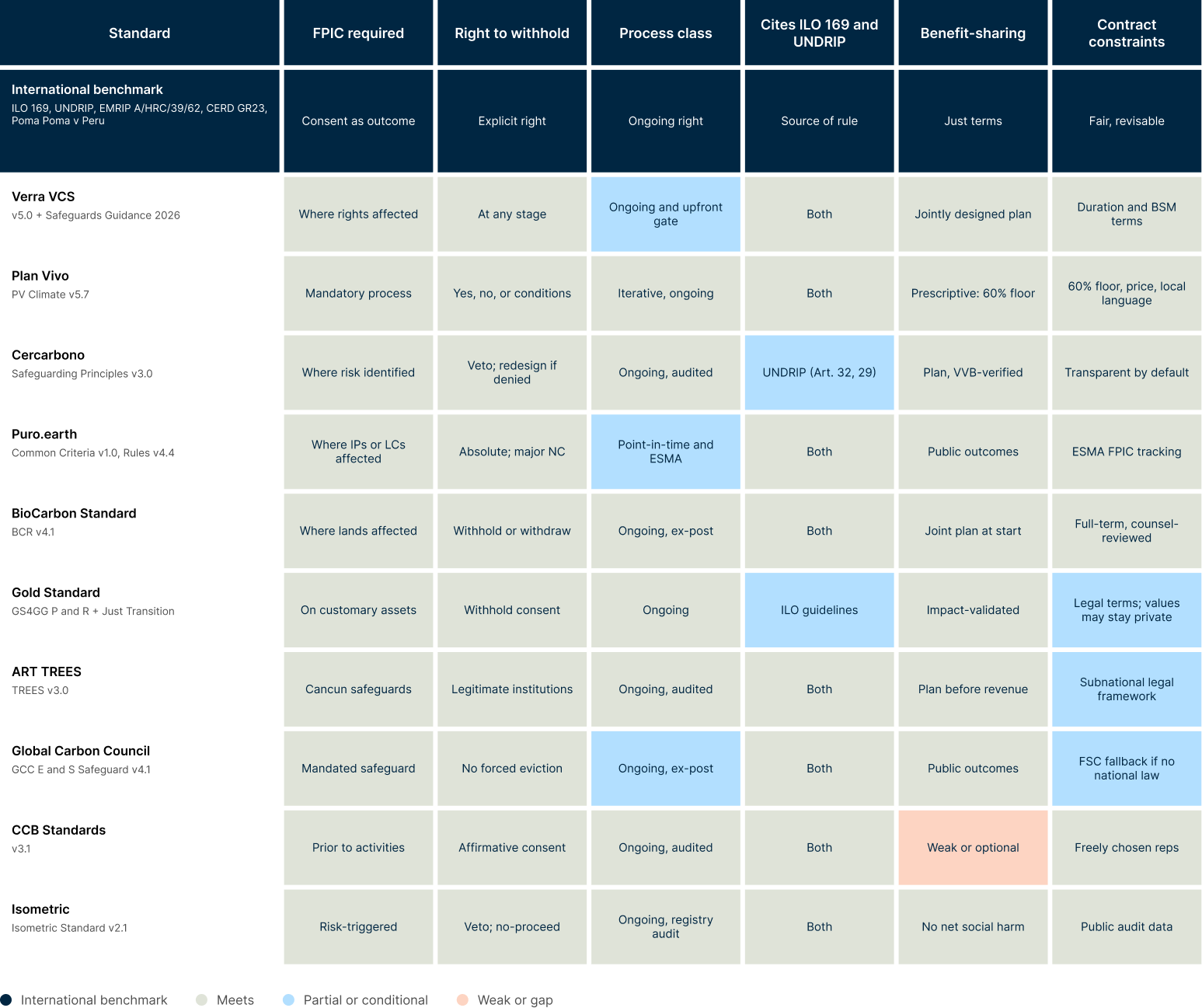
To better understand the FPIC requirements used in the market, we evaluated a sample of carbon crediting standards against six criteria, checking whether they guarantee FPIC, respect the right to withhold consent, treat it as a continuous process, align with international law, and ensure enforceable benefit-sharing and contract terms (see Figure 1).
The choice of standards represents a mix of those with operations in the countries that have adopted both ILO Convention 169 and UNDRIP and, particularly, those with nature-based solutions (NBS) methodologies or protocols and registered NBS projects.
Encouragingly, almost every major standard now mandates FPIC, respects a community's right to refuse, and treats consent as an ongoing process rather than a one-off checkbox. With most frameworks updated by 2026, the industry has fundamentally overhauled its safeguards in just 18 months, aligning directly with international human rights standards.
The most significant evolution is happening in contract oversight, where standards are now digging into the actual terms of the deal:
- Verra's VCS v5.0 now mandates that Project Implementation Agreements explicitly lay out both duration and benefit-sharing arrangements.
- BioCarbon insists on enforceable agreements that span the entire crediting period, vetted by legal counsel.
- Cercarbono is pushing for full transparency on benefit-sharing by default.
- Plan Vivo stands out as the industry's most ambitious standard: it stipulates a guaranteed floor of 60% of certificate income for participants and local stakeholders, making it the only framework to quantify this crucial feature.
The gap between FPIC documentation and on-the-ground operations: Where FPIC is at its weakest
Despite the progress on FPIC over the last few years, the market (and its critics) still observe a disconnect with operations on the ground. The main issue observed is the stringency and effectiveness of the oversight process.
Two points underscore the issue.
First, consent verification. Project developers are tasked with contracting the validation or verification body that checks the project practices against the standard requirements. In theory, oversight of FPIC practices is discussed and reviewed, but the evidence typically focuses on whether the process is well documented rather than questioning whether the practice leads to a continuum of consent as indicated by ILO169. Are communities truly understanding what they are signing up for? This is potentially a structural flaw in how consent is verified that may need revision and update.
Fieldwork from 2024–2026 across Indonesia, Brazil, and Peru reveals that consultations frequently feel like top-down directives rather than genuine dialogues, with communities viewing participation as a compliance exercise rather than meaningful decision-making. As one resident in Pará simply put it:
'REDD+ itself is not the problem; the problem is the way it is being imposed on us, without explanation.'
Second, the limitations on managing a living system. Most carbon crediting standards lack the vital infrastructure needed to turn a written clause in their requirements into a living process: a robust environmental and social management system that allows for a continuous discussion and consent over the lifetime of the registered project.
Without elements like a risk register, continuous monitoring, and clear corrective-action loops, these protections often remain static. A 2025 review of major standards noted this gap, finding that various standards (e.g. VCS and Gold Standard) lacked these management systems, with their FPIC provisions often failing to specify what ‘good-faith’ negotiation and documentation actually look like in practice. Plan Vivo remains the notable exception. Many of the standards continue working and updating their FPIC requirements.
FPIC as a design conversation
The carbon market operates with an embedded FPIC structural challenge: most projects arrive into communities with a PDD (Project Design Document), effectively asking communities to approve a plan they didn't help write.
Indigenous peoples steward nearly a fifth of the world's land and over half of its remaining intact forests, yet they are rarely involved in initial project design. In the Amazon, for instance, these territories hold an estimated 45% of intact forests despite contributing less than roughly 3% of regional emissions. Indigenous communities have successfully managed these ecosystems for generations, far longer than any carbon registry has existed. Integrating their knowledge at the design stage, rather than just the consultation phase, would place that expertise at the project's core.
This is what Osborne et al. call 'co-capacity building': a two-way exchange where communities gain fluency in carbon accounting, while developers learn to design with Indigenous governance rather than around it.
A community-first, human rights-centred approach
The Kichwa People of Sarayaku in the Ecuadorian Amazon are pioneering this shift, grounding their climate work in 'Kawsak Sacha' (the Living Forest), a declaration that treats the forest as a living entity with inherent rights, where the community leads and holds final authority. Similarly, Peru is pioneering an Indigenous-led jurisdictional REDD+ programme.
This movement is echoed in courts, from the 2024 Colombian ruling that annulled the Baka Rokarire project to a 2025 Brazilian decision suspending projects on Indigenous land.
While the market is finally bridging the consent-and-contract gap, the real frontier is design: moving from communities simply agreeing to projects to actively shaping them.
At Abatable, we evaluate projects through this human rights-centred lens; how a project integrates Indigenous knowledge and governance is often the strongest indicator of its long-term integrity. Find out more about our due diligence process or get in touch with our team.
Annex
How to read the scoring matrix: the six tests and the benchmark behind them
Each standard in Figure 1 is measured against a benchmark drawn only from international law: the International Labour Organization Convention 169 (1989), the UN Declaration on the Rights of Indigenous Peoples (UNDRIP, 2007), the UN Expert Mechanism on the Rights of Indigenous Peoples study on Free, Prior and Informed Consent (A/HRC/39/62, 2018), the UN Committee on the Elimination of Racial Discrimination General Recommendation 23 (1997), and the UN Human Rights Committee's decision in Poma Poma v Peru (2009). The benchmark row at the top of the table is that standard. Every row beneath it is scored against it.
Under the colour scheme, green means the standard meets the benchmark for that test. Blue means it meets it partly or conditionally, for instance, where a requirement exists but defers to national law or permits confidential terms. Red means a genuine gap.
Here is what each column tests, and what the international instruments expect:
FPIC required. Does the standard require Free, Prior and Informed Consent at all, and for whom? The benchmark treats FPIC as the expression of a people's right to self-determination (EMRIP, A/HRC/39/62, paragraph 3), owed to Indigenous Peoples and, in many framings, to other customary rights holders. We look for whether the requirement is triggered by the presence of rights holders rather than by a narrow test the developer applies to itself. Every standard reviewed requires FPIC in some form, so the nuance sits in the trigger.
Right to withhold. Can the community say no, and can it withdraw a yes it has already given? This is the heart of the matter. UNDRIP Article 32(2) requires states and proponents to obtain consent, not merely to seek it, and the EMRIP study is explicit that the right includes the right to withhold. A standard that documents a consultation but never states that the community can refuse, or that treats a signature as irreversible, does not meet this test.
Process class. Is FPIC a single gate at the start, or a living process across the project's life? The benchmark treats consent as ongoing, because circumstances, impacts, and terms change over a crediting period that can run 30 years or more. We mark a standard green where consent must be revisited and re-verified at defined points, blue where the language implies continuity without requiring it, and red where consent is captured once and considered settled.
Cites ILO 169 and UNDRIP. Does the binding text name the two core instruments, or does it gesture at 'international standards' without anchoring to them? Naming matters because it imports the instruments' definitions and obligations rather than leaving them to the developer's interpretation. A standard that cites both by name meets the test; one that relies on a downstream framework, such as the Cancún safeguards or another body's guidelines, meets it only in part.
Benefit-sharing. Does the community receive a fair, defined share of the value, and is that share enforced? The benchmark reads benefit-sharing as part of the consent itself: a community cannot give informed consent to terms it cannot see or has no power to shape. We look for a defined, auditable arrangement. Plan Vivo sets the only hard floor in the field, requiring at least 60% of certificate income to reach participants and local stakeholders, which is why it scores highest here. Standards that leave benefit-sharing to a principle of 'equitable distribution' without a mechanism score lower.
Contract constraints. Does the standard reach the terms of the agreement the community signs, its duration, its exclusivity, its exit rights, its revenue split, or does FPIC stop at the door of the project? This is where the standards have moved fastest, and where the differences between them are now sharpest. We mark a standard green where it constrains the contract in a way the benchmark would recognise, for example by requiring the term and the benefit-sharing terms to be stated, reviewed by independent counsel, and transparent by default; blue where a constraint exists but this defers to national law or permits confidential values; and red where the contract sits outside the safeguard entirely.
It is important to note that the matrix measures the strength of each requirement as written, not how well it is enforced in practice. As the article sets out, the two can diverge sharply: a standard can require ongoing, freely given consent and still certify a project where the consent was not free or ongoing.