Authors

Contents
Find out how we can help you navigate environmental markets
The process for accounting for emissions interventions within a company’s sphere of influence has evolved significantly over the last couple of years, with new insetting-related guidance providing a fresh landscape for corporate climate action. Holly Nicholson takes stock and unpacks how corporates may expand their climate contribution through within-value-chain emissions mitigation.
PepsiCo made headlines this summer by using Environmental Attribute Certificates (EACs) to lower its Scope 3 land-related emissions. The company accounted for emissions savings from regenerative agriculture activities located in its ‘activity pool’ – the region it supplies from.
The move is part of a notable acceleration in insetting practices and the use of EACs to address emissions within value chains, including by companies in consumer products, commodities trading, retail or food and beverages, such as Amazon and Kanematsu. In this piece, we explore the drivers and enablers of this shift in strategic direction and find that the momentum has been facilitated by updates to the guidance frameworks and traceability systems surrounding insetting, including the Greenhouse Gas Protocol’s rules for forest, land use and agriculture (FLAG) emissions and SBTi’s new corporate net-zero standard.
What are EACs?
EACs are tradable certificates that represent the environmental benefit of a specific activity, such as one megawatt-hour of renewable electricity, one tonne of carbon dioxide equivalent avoided or removed, or a volume of sustainable fuel used in place of fossil fuel. Because the certificate can be separated from the physical product, a company can claim the benefit even when it does not consume the physical electricity, fuel, or commodity linked to the certificate. The term covers a broad family of instruments, including Energy Attribute Certificates such as RECs and Guarantees of Origin, SAF certificates (SAFc), carbon credits, and newer intervention units such as Verra's new Scope 3 Units (S3Us).
How an EAC counts towards targets and GHG accounts depends on how it is generated and what it can be linked to. Energy Attribute Certificates describe the characteristics of the energy a company purchases, so they fit within inventory accounting and can already be used in market-based Scope 2 reporting under the GHG Protocol.
Carbon credits and intervention units (e.g. those developed under an insetting-specific program such as Verra’s Scope 3 Standard) are based on project-based accounting: they measure a reduction or removal against what would have happened without the project (the baseline). Until recently, these units sat outside a company's inventory and could only support offsetting claims. Where a company can now show that a project sits within its value chain or sourcing region, using tools such as the AIM Platform Association Test or the traceability requirements of the GHG Protocol Land Sector and Removals Standard (LSRS), the reduction or removal can be reported against its Scope 1 or Scope 3 emissions and contribute to value chain targets.
How does the new standards landscape support insetting and the use of EACs?
To demonstrate their commitment to the environment and reducing emissions, companies would historically source different types of credits and certificates from outside company value chains, including RECs, SAFc, or carbon credits. However, while there was a market-based accounting option for Scope 2, the lack of a mechanism to account for the use of EACs for Scope 1 and 3 means they would seldom contribute toward emissions reduction and net-zero targets without being subject to scrutiny.
This trend is actively shifting, with companies beginning to leverage their decades-long experience of the carbon market to develop and/or source carbon credits and EACs that can be traced to their value chain and therefore claimed against their emissions usage.
This strategic shift is the result of the harmonisation of target setting, net-zero, and corporate GHG accounting standards, providing a clearer route to the use of carbon credits and insetting intervention units as EACs. More specifically, new and updated traceability standards and guidance, such as the GHG Protocol LSRS or AIM Platform Association Test, provide greater optionality for the use of EACs and insetting claims. The role of crediting and certification standards remains – setting the requirements and integrity conditions to comply with to certify results and issue the EACs (Figure 1).
Using carbon credits as insets follows essentially the same chain as their use as offsets except, as Figure 1 outlines, there are additional layers of traceability and rules to follow for GHG accounting.
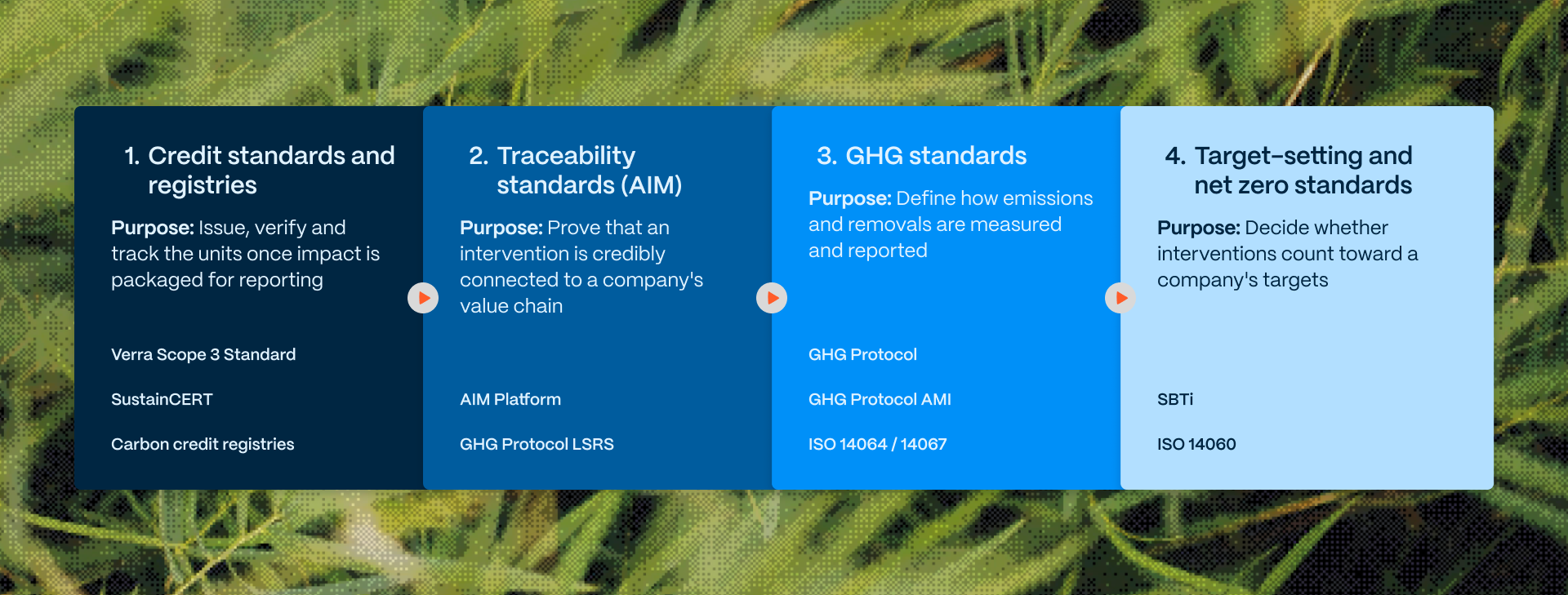
The process sees:
- Suppliers to the market develop emission-reduction projects or interventions according to insetting-specific standards and methodologies (such as Verra’s new Scope 3 Standard and SustainCERT), or develop or source credits from carbon projects within their value chain generated under ‘traditional’ carbon credit standards.
- Depending on the sector, project type, or commodity, companies collect evidence and documentation that the project or credit can be claimed by them and only them. Guidance that supports this includes the AIM Platform Association Test, or the GHG Protocol Land Sector and Removals Standard (LSRS). Read more on those here.
- Based on the level of traceability, companies can report their interventions in accordance with GHG inventory reporting standards, such as the GHG Protocol or ISO 14064.
- Claims can then also be made under net-zero target standards, including the SBTi Corporate Net Zero Standard V2.0.
What’s changed to facilitate this pathway?
Many of the frameworks enabling interventions have been built and tested in the last year, as outlined in Figure 2.
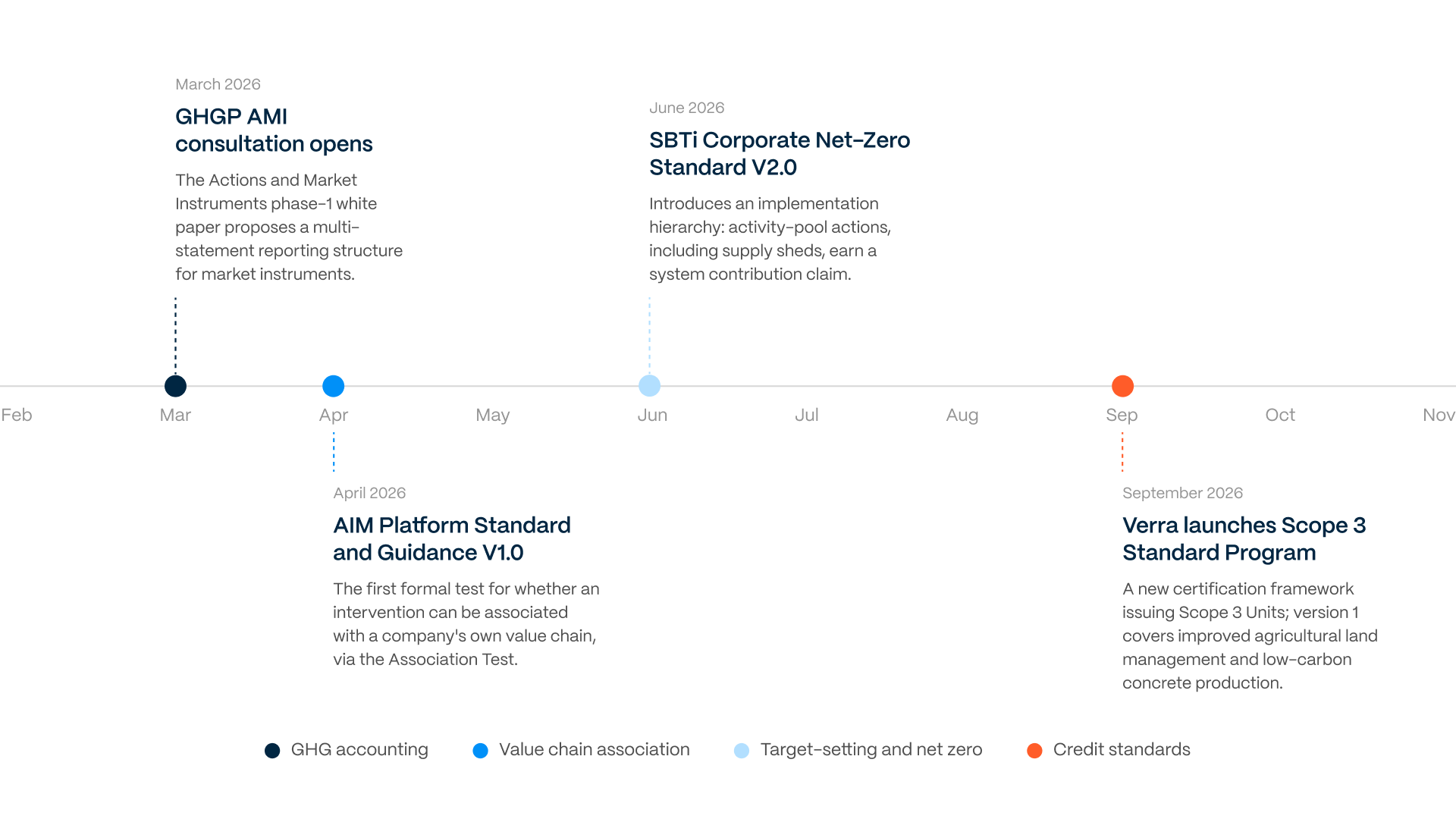
In March, the Greenhouse Gas Protocol opened consultation on its Actions and Market Instruments (AMI) framework, a draft multi-statement structure that reports carbon credits and other market instruments separately from a company's physical inventory, which has recently received broad support.
In April, the AIM Platform published its Standard and Guidance V1.0, introducing the Association Test: the first method for credibly linking an intervention to a company's value chain.
In June, SBTi published its Corporate Net-Zero Standard V2.0, introducing an implementation hierarchy that recognises activity-pool actions, including interventions within a shared sourcing region.
Finally, in September, Verra launched its Scope 3 Standard Program, giving project developers a formal framework to certify and issue Scope 3 Units (S3Us) for interventions inside a company's value chain.
What does this mean for companies?
This ecosystem is still developing, however the clear direction addresses two pain points companies have had for a long time.
First: If I do not have full traceability in my supply chain, or if new technologies are not available in my region, how can I make investments to reduce value chain emissions?
Now, EACs separate from the commodity, so, for example SAF can be used and reported towards GHG inventories and net-zero targets when sustainable fuels are not available at that specific airport.
Second: We've invested in value chain interventions for years, so why haven't we been able to claim them in our emissions accounts?
Now there are new tracking systems for companies to claim the units (e.g. Verra’s Scope 3 Standard), frameworks to prove that the intervention can be claimed within a company’s value chain (e.g. AIM Platform), and an incoming multi-ledger GHG accounting system for companies to demonstrate their investments and interventions that may not show up in gross GHG emission values.
This is likely to catalyse such interventions and provide sustainability and climate teams with greater justification for making investments within and around value chains.
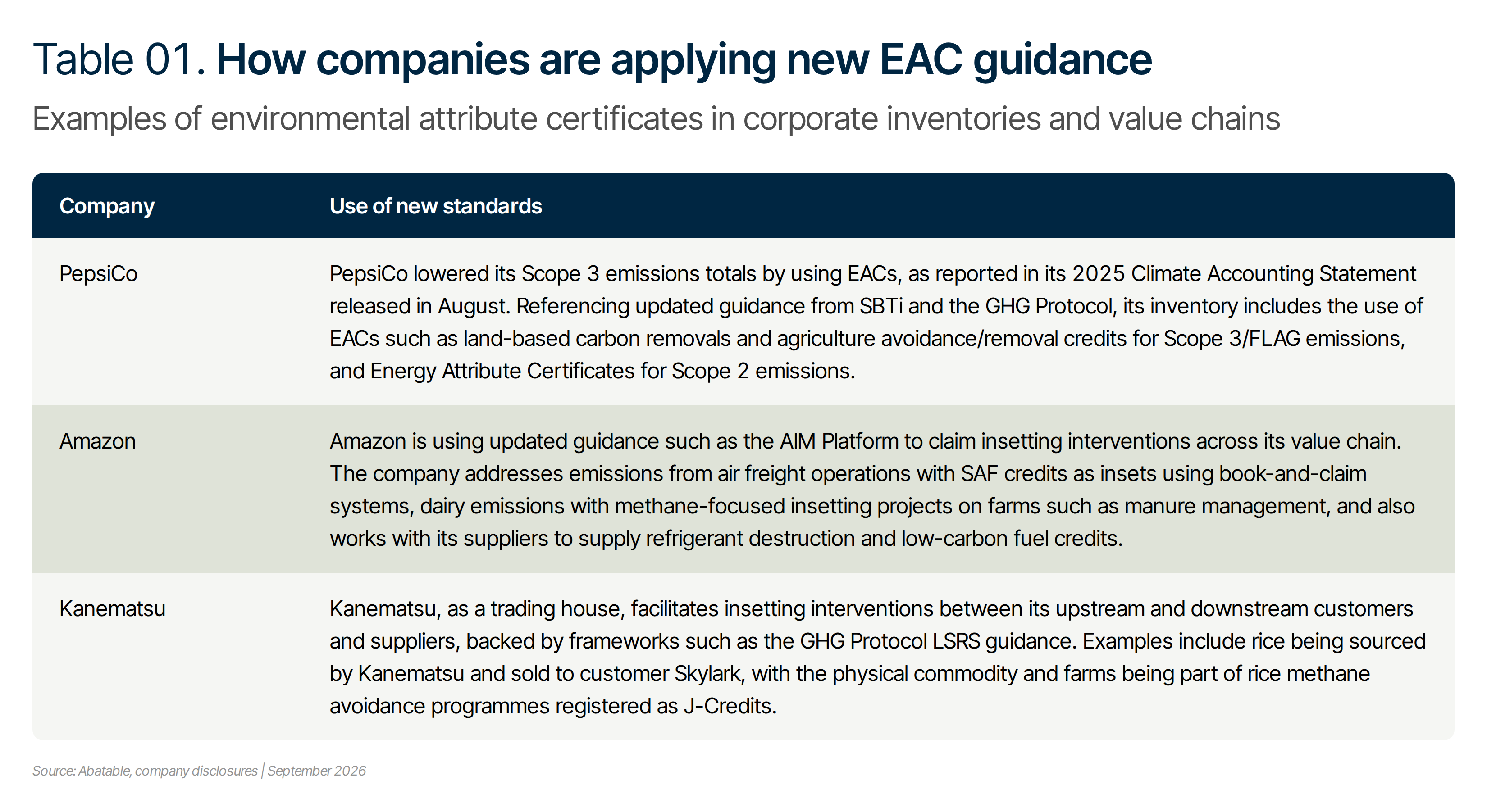
The new standards are fundamentally impacting how companies are using carbon credits and EACs so that parties across the value chain can benefit from emissions avoidance or removal, as outlined in Table 1.
Advanced companies' carbon credit and EAC portfolios are evolving from a set of unrelated projects procured annually outside the value chain, to a mix of projects that can be claimed as insets, removals for net zero, and credits outside the value chain that contribute to broader sustainability and resilience goals.
This is giving companies more levers to pull to make an impact across and outside value chains, and enabling them more opportunities to report these impacts.
Abatable has been strategising with our clients to make the most of the new guidance outlined in this piece: building insetting programmes, sourcing carbon credits and other EACs within sourcing regions, and stress-testing claims against current and future guidance. To learn more about how we can help, contact the team.