Authors

Contents
Find out how we can help you navigate environmental markets
The European Commission has outlined its proposal for a revised EU Emissions Trading System designed to protect European competitiveness while still – according to the Commission – allowing the bloc to meet its 90% by 2040 emissions reduction target. What are the main elements and the implications for European companies and carbon credit markets?
Key takeaways
- The European Commission has proposed that a proportion of EU ETS revenue flows to permanent carbon removals and international carbon credits – mechanisms that Brussels has long kept out of the scheme in favour of pure domestic abatement.
- Permanent carbon removals (BioCCS and DACCS) would get a genuine, if narrow, compliance buyer from 2031: the Commission itself, funded by 250mn additional allowances that are netted off against the removals bought, rather than loosening the emissions ceiling.
- International carbon credits will have their own purchasing facility from 2036, but the proposal doesn't define which international credits will be eligible and proposes a review of the facility based on the availability of high-quality international (Article 6) credits in 2033.
- A new €100bn Industrial Decarbonisation Bank will formalise funding for industrial decarbonisation and removals, and is arriving as the public share of European carbon removal funding is already falling.
- The proposals are not final. The European Parliament and the Council must each negotiate their own positions before the revisions become law.
Overview
The European Commission has published its proposed overhaul of the EU Emissions Trading System (ETS), the world's first and largest compliance carbon market. The review, requested by the Council in March, is intended to keep the ETS aligned with the EU's legally binding target of a 90% cut to emissions by 2040 relative to 1990 levels, while responding to industry concern about carbon price volatility and energy costs.
The proposal includes several developments that would, for the first time in its 21-year history, open the compliance market to the use of international carbon credits and carbon removals. While the system originally allowed participants to meet some of their obligations using Clean Development Mechanism (CDM) credits when it launched in 2005, these were phased out starting in 2008 and were disallowed by 2020. The EU now proposes to use funds raised from the sale of allowances to purchase international carbon credits and carbon removals certified under the EU’s CRCF programme.
The proposal also makes changes to three key mechanics of the scheme:
LRF: The EU caps the amount of emissions the ETS permits each year and issues emissions allowances – tradeable permits – to the level of that cap. The scheme’s ‘linear reduction factor’, or LRF, is the fixed percentage by which the cap tightens annually to reduce overall emissions from facilities covered by the ETS.
The LRF was calibrated to shrink the cap by 4.3% a year until 2030, then 4.4% from 2031. The proposal slows that to 3.7% for 2031 to 2035 and 1.7% from 2036, so the cap declines more gradually and a larger volume of allowances stays in circulation each year than under the current schedule.
MSR: The Market Stability Reserve (MSR), established to make the ETS more resilient to imbalances between supply and demand, withholds a share of surplus allowances from auctions when the market is oversupplied, and releases them when it tightens. The proposal halves the share it withholds each year, known as the intake rate, from 24% to 12% from 2028. This will make more allowances available to participants.
Free allowances: Free allocation of emissions allowances for energy-intensive industries such as steel, cement, and chemicals would be extended through 2040. These would be conditional from 2031: 80% would be released annually once a company submits a verified decarbonisation investment plan, with the remaining 20% supplied only once delivery is verified at the end of each five-year period. Separately, the phase-out of free allocation for sectors covered by the Carbon Border Adjustment Mechanism (CBAM), previously on track to reach zero by 2034, is delayed to 2038, with 15% of already-reduced allowances reintroduced from 2028.
International carbon credit and carbon removal integration
The Commission’s proposal creates two distinct routes for the ETS to draw on carbon removals and carbon credits: permanent carbon removals, certified under the EU's own framework, from 2031; and international carbon credits from 2036.
Permanent carbon removals and the CRCF
From 2031, the European Commission proposes to use revenue from the sale of 250mn allowances to buy permanent removal units – bioenergy and carbon capture and storage (BioCCS) and direct air capture with carbon storage (DACCS) – certified under the EU's Carbon Removals and Carbon Farming (CRCF) framework. This is the first time permanent removals would have a compliance buyer in the EU ETS.
Notably, the Commission, not individual companies, would be the buyer, funded through allowance auction revenue rather than direct purchases by obligated entities. This reflects market dynamics: BioCCS and DACCS currently cost significantly more than an EU allowance, so there is little commercial incentive for a steel or cement producer to voluntarily purchase removals over allowances at today's prices.
Abatable's own vintage forward price curves show that buyers expect DACCS costs to fall steadily, from a fitted medium price of around $978/tCO2e in 2026 to roughly $376/tCO2e by 2032, before edging back up slightly by 2035. Even at their low point, DACCS prices remain several times the cost of an EUA, which traded between €79 and €82 in July 2026. The remaining commercial gap is what this compliance-buyer mechanism is designed to bridge. Soil carbon and other nature-based removals are excluded for now, deferred to a review at the end of 2034.
International carbon credits
From 2036, the Commission proposes to use auction revenue from up to 260mn allowances to fund a dedicated facility that purchases high-quality international carbon credits, which may include those issued under Article 6 of the Paris Agreement, and use them to help reduce the EU's own domestic abatement requirement by up to five percentage points (allowing an 85% domestic reduction rather than 90% by 2040).
This sits inside the 5% ceiling the European Climate Law already allows for international credits, and it is the first time compliance market revenue has been earmarked for their purchase at this scale. This is a meaningful demand signal for Article 6 carbon project developers, even if it arrives a decade from now.
The eligibility criteria for these credits are yet to be defined, and a review of the mechanism is scheduled for 2033, contingent on the availability of high-quality international credits.
Funding the transition through the Industrial Decarbonisation Bank
The Commission also proposes establishing an ‘Industrial Decarbonisation Bank (IDB)’ from 2028, which can be used to fund carbon removals.
With a target of mobilising €100bn for industrial decarbonisation, the IDB would operate in two phases. The first, the ETS Investment Booster (2028 to 2031), would reserve 400mn allowances to provide fixed carbon premiums to decarbonisation projects on a first-come, first-served basis, with a dedicated share set aside for lower-income EU member states.
The second phase, from 2031, shifts to competitive Carbon Contracts for Difference or carbon premiums, giving longer-term revenue certainty to de-risk investment. The IDB explicitly covers installations capable of generating permanent carbon removals, directly linking its financing to the CRCF pipeline. It sits alongside an extended Innovation Fund (200mn allowances, for first-of-a-kind technology) and a reformed Modernisation Fund, which channels revenue to lower-income member states and now also covers electrification and industrial decarbonisation.
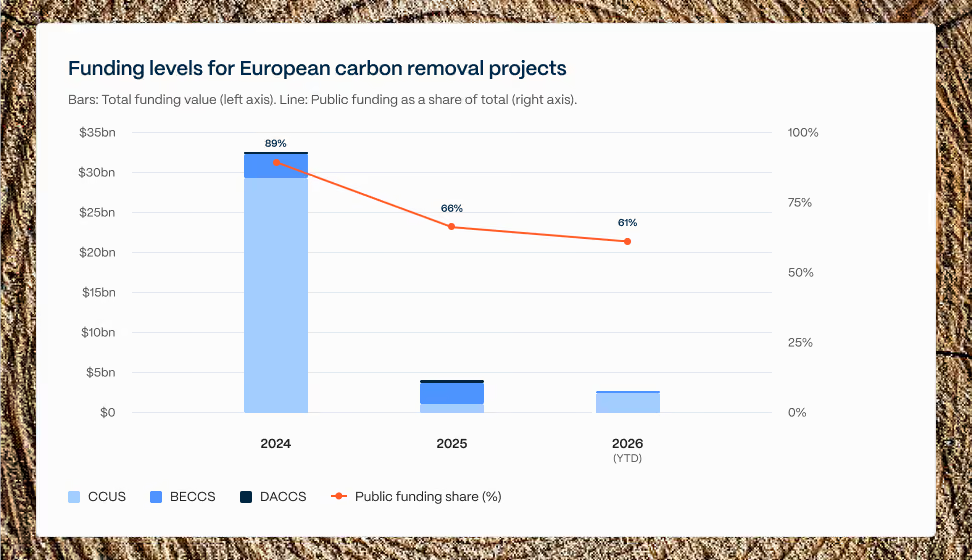
This funding arrives as public investment in carbon removals has been falling. According to Abatable's market intelligence funding data, European carbon removal projects have attracted $39.7bn in investment since 2024, of which CCUS technologies account for 83% ($32.84bn), and BioCCS and DACCS significantly less (see Figure 1). But the share of that funding coming from public sources has fallen from 89% in 2024 to 61% in the year to date in 2026 ($1.71bn of $2.80bn raised so far this year).
Only a proposal, for now
None of this is agreed law yet. It is a Commission proposal, and the European Parliament and the Council of the EU must each produce and negotiate their own positions before anything here takes effect. The Commission's own target is to conclude that process by the first quarter of 2027, a tight timeline given the scope of the negotiations.
There is a long timeline for the proposals – removals enter the market from 2031, and international credits from 2036. But both approaches give the removals and Article 6 markets something they have never had from the EU ETS before, a defined compliance buyer with a number attached. The eligibility criteria, percentages, and soil carbon's place in all this will still be negotiated over the coming year, and developers watching this process now have a real reason to stay close to it.